


Home
 BlogServices and ToolsHow to Check If Your Content Is AI-Generated (Step-by-Step Guide)
BlogServices and ToolsHow to Check If Your Content Is AI-Generated (Step-by-Step Guide)
How to Check If Your Content Is AI-Generated (Step-by-Step Guide)
Services and ToolsHow to check if content is AI-generated? Get to know basic ideas on how to identify patterns, phrasing, and weak depth. Our tests indicate what to look at and how tools assist. See how to verify your text step by step.
At We-Right Factory, we maintain a fair, data-driven approach. This material may contain affiliate links, though that never influences our findings. We count on practical checks, actual use cases, and transparent criteria.
According to Ahrefs research, 74.2% of newly published web pages contain AI-generated content. That number continues to rise. AI content lacks depth, misses context, and reads flat – readers usually notice it. Human writing builds trust, signals expertise, and works more effectively in the long run.
The We-Right Factory team conducted a series of tests and analyzed common trends across hundreds of AI-generated texts. We know how to recognize generated text, understand the patterns and weaknesses of AI, and are ready to share this experience. Here’s how to tell if content is AI-generated.
Why AI Content Is Easy to Spot (When You Know What to Look For)
AI follows templates. All the AI robots available are trained on the same data, so the output will look similar across tools and topics. The lines are the same – they have similar forms, wording, and rhyme. After clocking them, it takes less than a minute to spot AI content. Here’s why AI content is easy to detect:
- Similar structure. AI constructs each and every piece of writing with the same intro-body-conclusion framework, with no differences at all.
- Sentence patterns. The length of the sentences remains constant all the way through – no short sentences which are interspersed with long sentences.
- Filler phrases. “It’s worth mentioning” and “In conclusion” are used in almost every AI-generated draft out there.
- Word choice. AI selects the most frequently used synonym each time and doesn’t use field-specific words.
- Logic depth. Items are added to the list but never developed – AI summarizes subjects rather than explaining them.
- Predictable flow. The transition between paragraphs is read identically at the start and finish of each paragraph.
- Tone flatness. There’s zero personality in writing, and zero personality in reading, the same writing topic, the same reading topic, regardless of the article specialization.
Step-by-Step: How We Check If Content Is AI-Generated
There is a specific order that we use in AI content checks. Each step targets a specific level of the text: structure, language, logic, and tool verification. Read them consecutively, and you have a clear read of any piece. Here are the steps in detail.
Step 1: Scan the Structure First
The quickest tell is structure. AI tools fall to templates – there’s no variation in the output. Scan the flow of sentences and the layout of the piece, and then read the actual content. A single surface assessment alone provides you with a good indication. The following are what to look at:
- Uniform sentence lengths. All sentences have approximately the same number of words. The combination of short, punchy lines and longer lines is a natural occurrence in human writing. AI makes everything flat and at an even pace.
- “Perfect” logic. In every paragraph, a point is established and neatly closed. No loose ends, no half-ideas. It sounds more like an outline rather than an actual argument.
- Predictable flow. The piece looks like this: intro → point → summary, then repeats the same cycle. No detours, no tangents. Authors can provide more depth and context – AI follows the template.
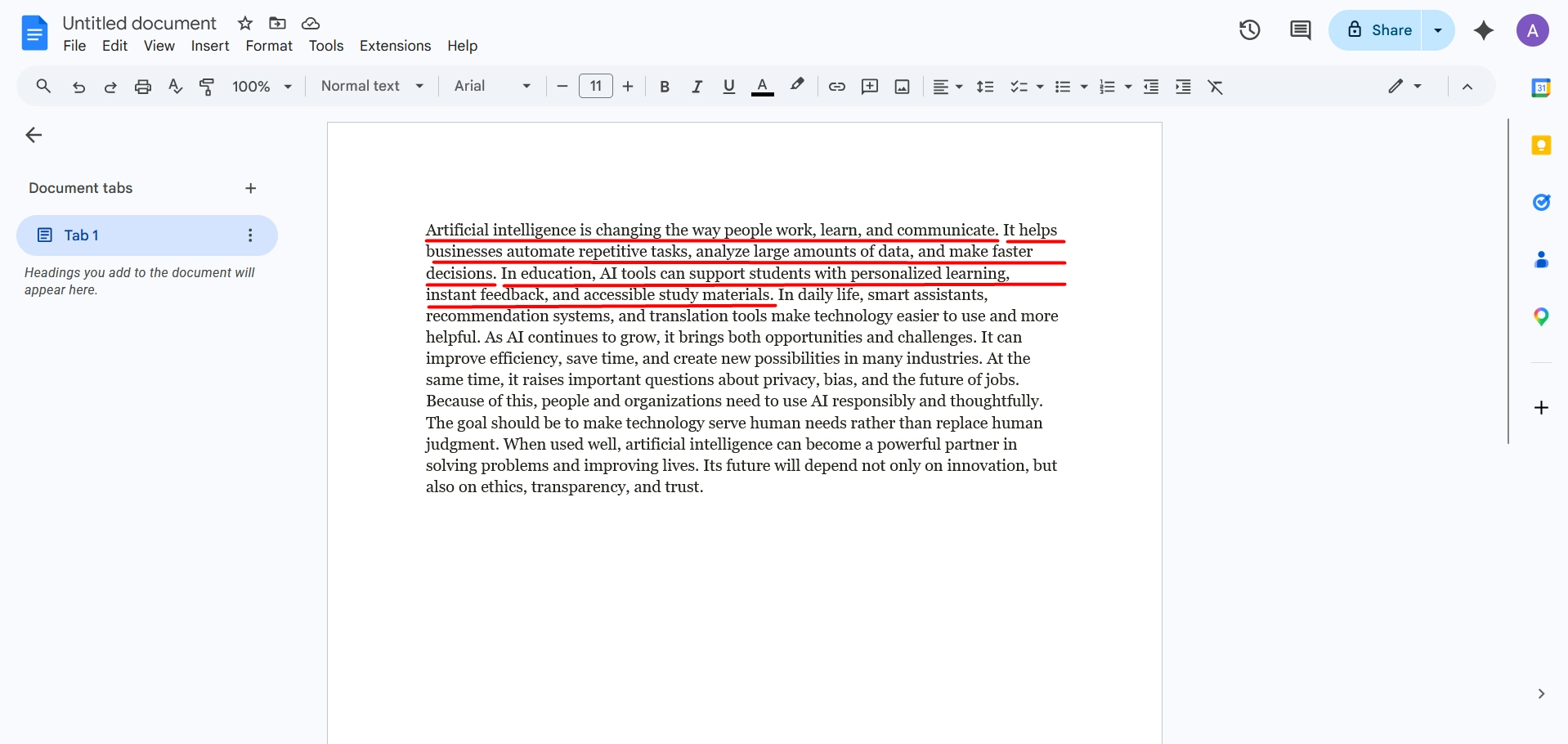
We have tested a sample of AI drafts and human articles. We observed this same plan of recurrence in the majority of AI texts. We also observed that the minor corrections did not disrupt this trend. You can see the example of the standard AI sentences in the following screenshot.
Step 2: Find Repetitive Patterns and Phrases
The same sentence constructions are repeated throughout the work, as generated by AI. Different paragraphs, same skeleton – that repetition is a visible signal because human authors disrupt rhythm, AI adheres to it. Take out some of the sentences and place the structures next to each other. The key indicators include:
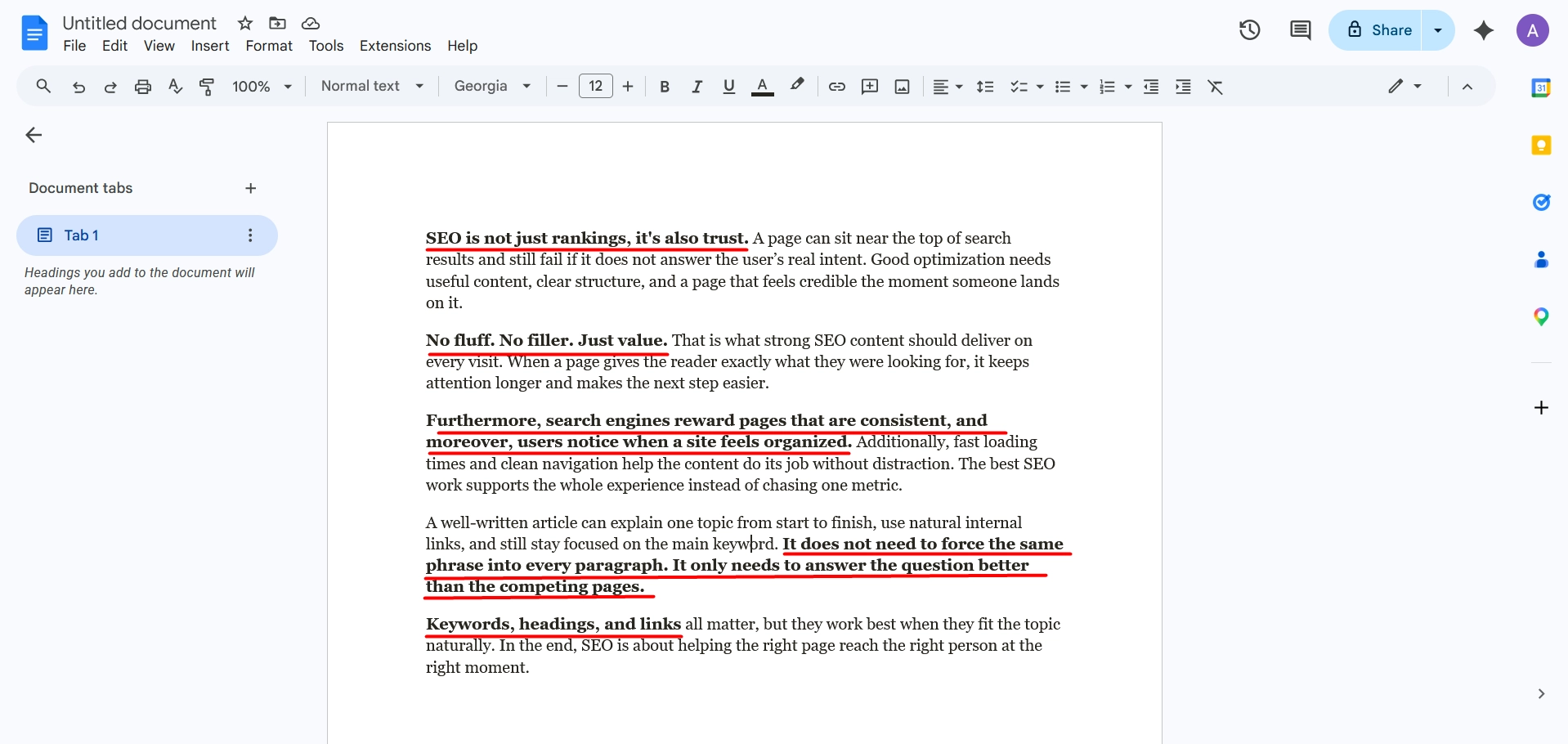
- “X is not just X, it’s also Y”. This is a construction that appears in nearly every AI text. E.g.: “SEO is not just rankings, it’s also visibility.” No man writes that sentence spontaneously – it is a filler construction that the model falls back on.
- “No X. No Y. Just Z.”. It’s a clear conclusion, usually made up of three parts. For example: “No fluff. No filler. Just results.” It sounds more like a slogan, not a sentence. Human authors don’t use it this way.
- Overused transitions. “Furthermore,” “Moreover,” “Additionally” – back to back, paragraph after paragraph. Human writers replace natural connection phrases or simply omit them.
- Repetitive 3-item lists. AI will always adhere to lists with 3 items. For example: “fast, reliable, and scalable.” Human authors don’t automatically group all the ideas into 3 points.
Here you can see a real example of text with AI patterns that we described above:
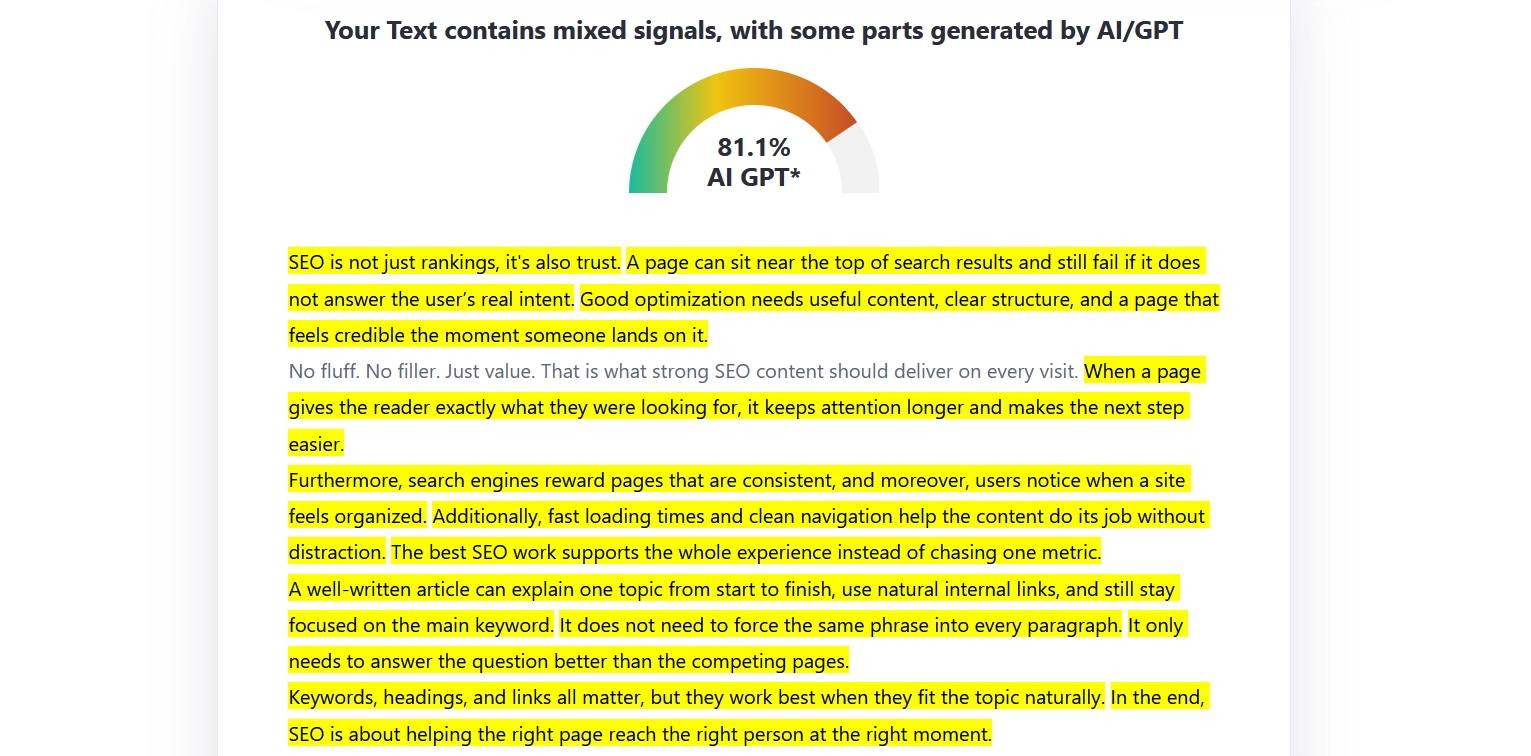
As you can see, the AI checker tool clearly identifies this text as generated, with an 81% probability.
Step 3: Analyze Word Choice
Words are a strong criterion. AI relies on the most common word set and doesn’t account for anything niche or field-specific. The outcome is writing that reads as polished but not personalized; that is, there’s no personality and nothing specific. Look especially at the following words:
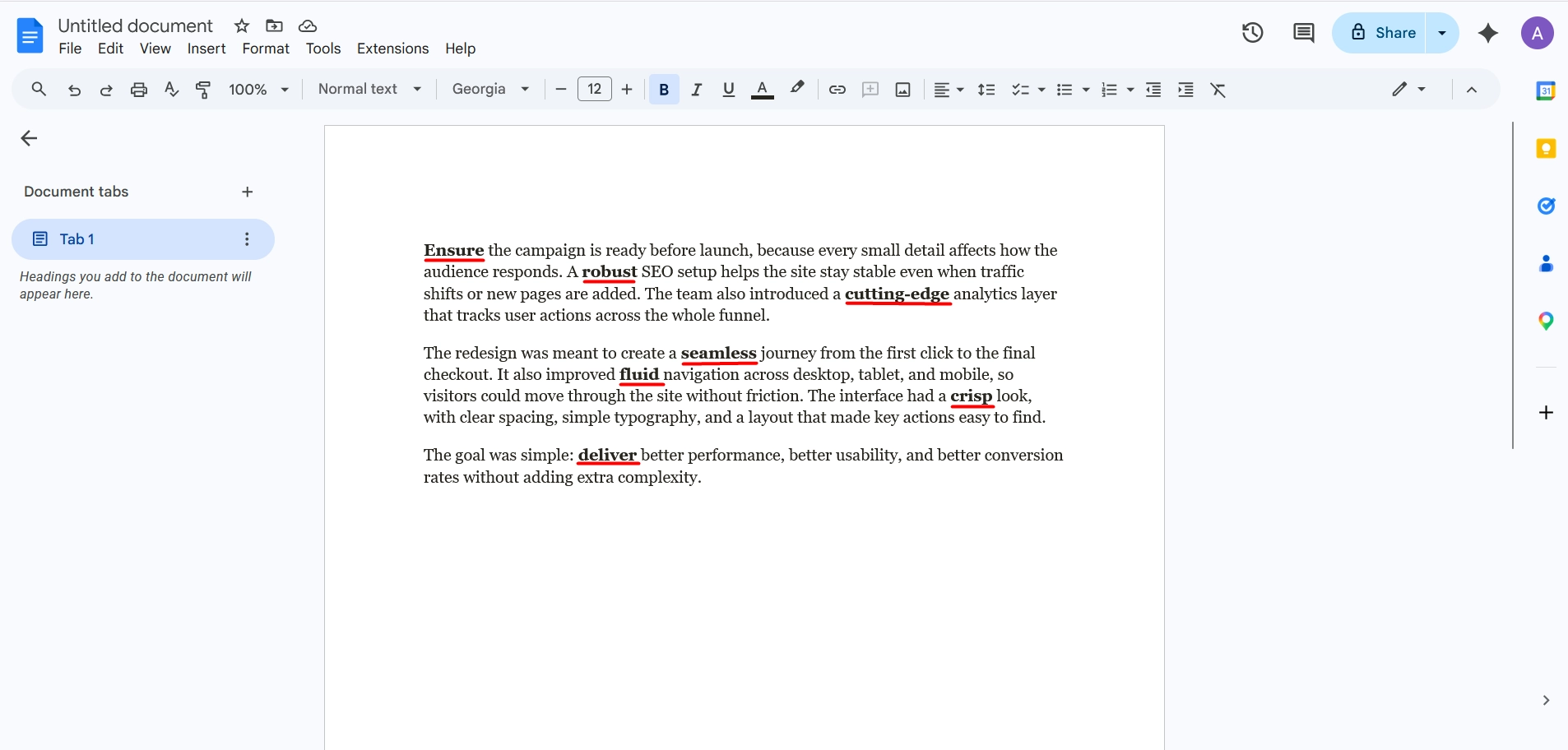
- Ensure. “This will ensure optimal results.” Since no one uses ensure in real-life conversations, it is a formal filler that AI defaults to at all times.
- Robust. “A robust solution for your business.” Vague and overused. It is an indication of nothing definite as to what the thing actually does.
- Cutting-edge. “Cutting-edge technology for modern teams.” Empty descriptor. True authors refer to the technology, rather than the coolness.
- Seamless. “A seamless user experience.” Always appears near UX or onboarding copy. Meaningless without specifics.
- Fluid. “Fluid navigation across all devices.” Same problem – sounds good, says nothing.
- Crisp. “Crisp, clean design.” Design writers don’t use this word. AI does, repeatedly.
- Deliver. “We deliver results.” Trigger because it pairs with vague nouns – results, value, solutions. Human writers say what specifically gets delivered.
Our experts analyzed multiple AI texts – these words were repeated in most of them. You can see a real example below:
Read also our article: Surfer SEO vs Ahrefs: Which Platform Makes More Sense in Practice?
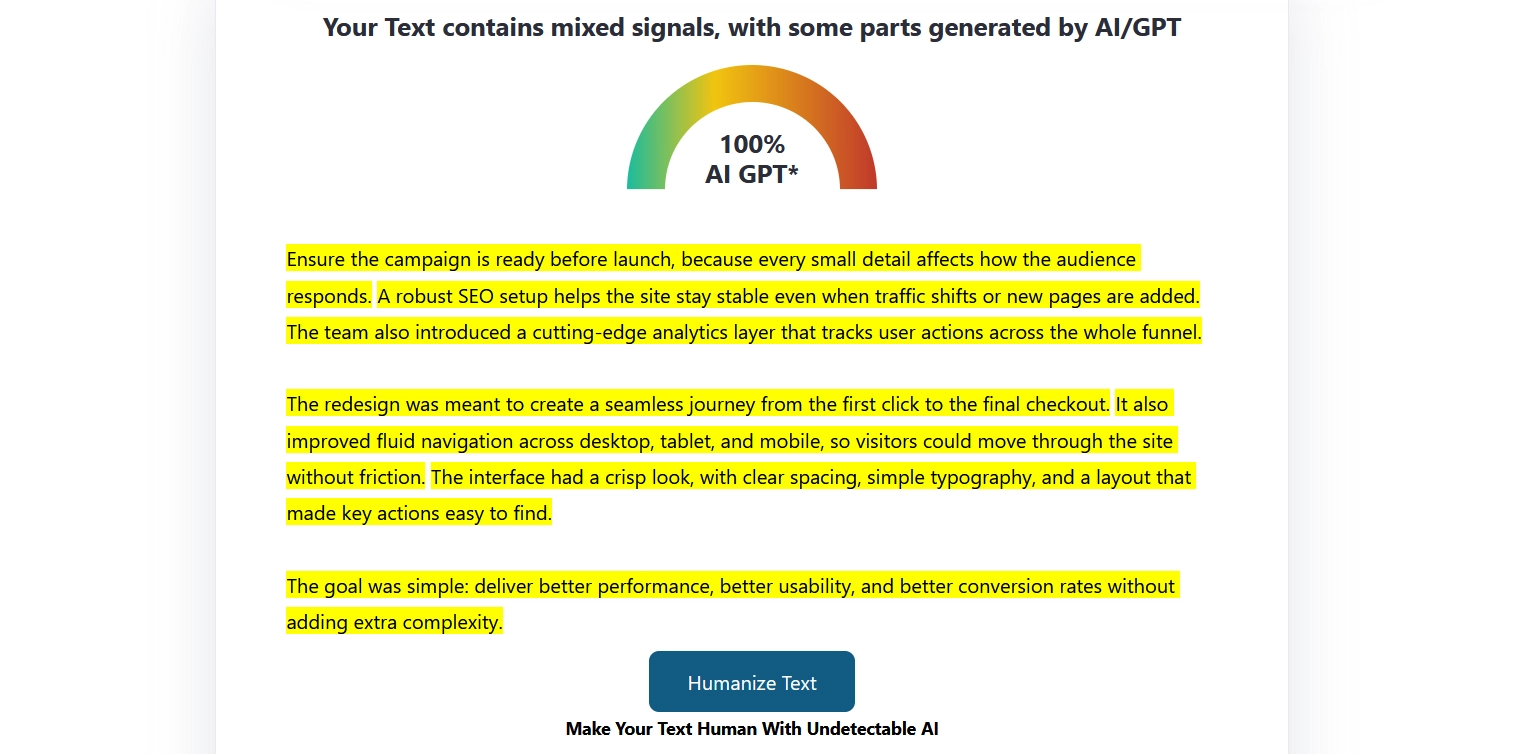
As in the previous case, the AI checking tool clearly sees this text as generated:
Step 4: Check the Logic and Depth
A signature of AI is surface-level writing. The tool discusses a subject without discussing it in detail, without providing information, details, and real-life situations. A copywriter who knows the subject writes with detail, AI summarizes. Such a difference in depth is one of the strongest indications in the entire check. The key markers are as follows:
| Options | AI content | Human content | Descriptions |
| Writes in generalities | This enhances the performance of websites, | We have changed to lazy loading, which reduced our page load to 1.1s on mobile versus 3.2s on desktop. | True authors put numbers, names or conditions on each claim. |
| No actual experience | Testing is one of the key elements of the development process. | We found a payment bug during staging that had the potential to break checkout for Safari users. | Human writing is a mention of an event that transpired; AI writes about ideas. |
| No details | There are a number of ways you can go. | We conducted three experiments – A/B testing, session recording, and heatmap – and only one of them moved the needle. | AI names categories. The author’s name specifics. |
Step 5: Use AI Detection Tools (But Don’t Trust Them Blindly)
Detection tools apply AI markers to patterns similar to known AI output. They are fast and convenient for an initial text check. The most popular tools for AI detection are:
- ZeroGPT. It has stringent requirements for uniform formatting and repetitive words, which makes it a good solution for quick scanning.
- Originality.ai. It is highly sensitive; it identifies slightly edited AI work, where other tools would show as human text.
- Copyleaks. Scans the phrasing and sentence structure, performs well when verifying multilingual work.
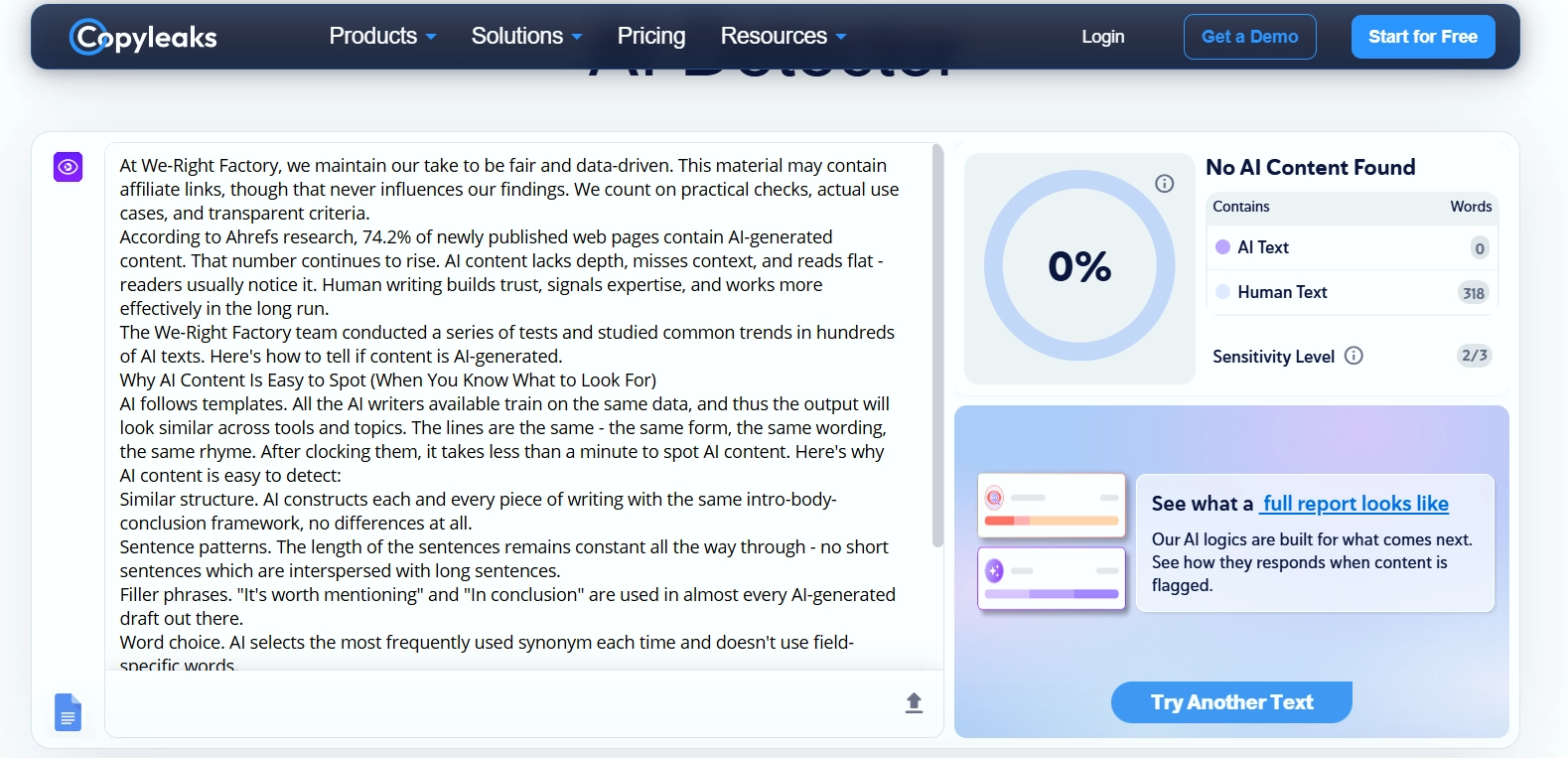
An AI score is an indicator, not a final verdict. Detection scores depend on the degree of editing, the subject, and the writing style. Use detection output as one data point – compare it with the manual checks we reviewed above to get a 100% verified result of the content.
We used these tools to process the same texts. The platforms showed different results and had different sensitivities. The most sensitive is Originality.ai, while Copyleaks and Zerogpt are less triggered by AI markers.
Real Case: AI vs Human Text
To demonstrate the difference in practice, we prepared a side-by-side comparison of the same content: one version was generated by AI, and the other was rewritten by a copywriter.
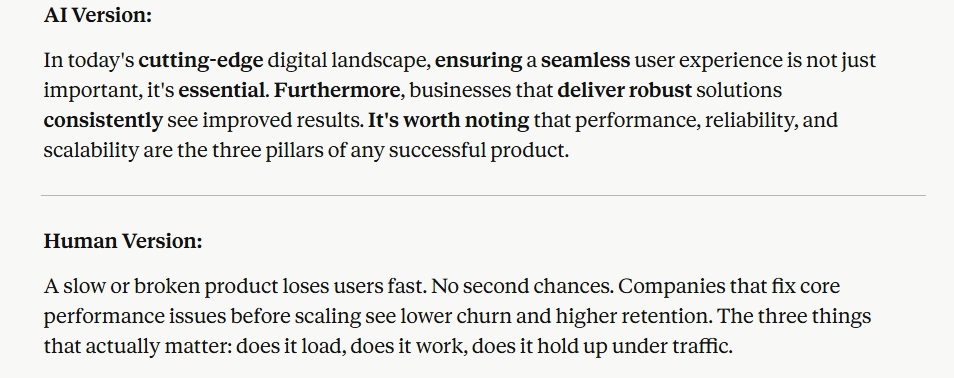
In the following table, you can find what each marker looked like in the original text, why it was a red flag, and the specific fix we made.
| AI marker | What it signals | How we fixed it |
| Cutting-edge digital landscape | Blank introductory text which establishes context | Added out of context |
| Ensuring a seamless experience | Inaccurate filling expression that has no information | Substituted by a specific consequence |
| Not just X, it’s also Y | Classic AI construction | Made the construction shorter and retained the idea |
| Furthermore | Overused transition | Removed – without it, sentences connect in a natural manner |
| Deliver robust solutions | Typical corporate wording | Substituted with real outcomes: churn, retention |
| It’s worth noting | An introductory text that adds nothing | Deleted – the sentence is not essential |
| Performance, reliability, and scalability | Automatic list with 3 items | Reframed as 3 closed questions of real meaning |
Our Final Thoughts
AI text contains patterns. They can be trapped by structure, wording, and the lack of detail. There are detection tools available that can assist, but a self-review is more important. Ideal results can be achieved by reading the context, flow, and real examples simultaneously.
FAQ
Is 40% AI detection bad?
No, a 40% AI detection score is not automatically bad. Patterns, rather than intentions, are detected by tools. A 40% score implies that the text has constructs that are similar to AI – you should not make any conclusions before conducting a manual review.
What are the signs of AI-generated content?
The use of a dull tone, repetition of the sentence structure, vague statements, excessive use of transitions, generic language, and total lack of actual detail or specific data in the text.
How to prove you didn’t use AI?
Share drafts, revision history, or notes on sources. Specific personal experience, original data, and a consistent writing style throughout your work are more powerful evidence than any tool metric.


You might also like
Discover other helpful articles handpicked for you, based on popular topics and recent publications.

A low Surfer SEO score does not always mean a weak page. It is just a guidepost, not a verdict on quality. Let’s find reasons why the score stays low and check the exact steps that improve it fast, and polish the text.
 May 20, 2026
 392
392

Is there a consensus regarding the same text when using AI detectors? We tried Copyleaks, ZeroGPT, Undetectable.ai, Originality, and Turnitin Checker AI to understand which tools will flag AI, and why their results are horrible.
 May 14, 2026
813
May 14, 2026
813
Surfer SEO and Ahrefs solve very different SEO problems. One focuses on content optimization and editorial workflows, while the other is built around research, backlinks, and SEO analysis. In this comparison, the We-Right Factory team breaks down where each tool performs best, what limitations matter in practice, an...
May 7, 2026
267

Grammarly and QuillBot solve different writing problems, and choosing the right one depends on what you actually need. We tested both tools in real writing scenarios – from grammar-heavy drafts to paraphrasing tasks – and broke down six key differences that matter in practice, not in marketing claims.
April 30, 2026
694
Our We-Right Factory SEO specialists will talk about three of the most popular keyword density checker tools: Istio, Seoscout, and Checkserp. We will explain how to use these services and their key benefits.
April 30, 2026
821
Want to know if a text was written by ChatGPT or a real person? Explore the best AI detectors for Google Chrome – tested tools that reveal how authentic your content really is. We reviewed their features, accuracy, and integrations to help you choose the most reliable option for everyday use.
April 30, 2026
3866
The We-Right Factory team will share all the details about the Copywritely service, including all the available instruments and key benefits and drawbacks. We will also share a simple registration instruction.
April 30, 2026
616
Smodin.io helps you verify text originality, detect AI-generated writing, check plagiarism, and ensure grammatical accuracy. Discover its top 5 tools, pricing, and expert insights in our full review.
February 4, 2026
964
We-Right Factory experts will research the features of the Surfer SEO service and determine whether they are efficient. The article also contains information about premium plans and a registration guide.
February 4, 2026
843

Our We-Right Factory copywriters will complete the ZeroGPT review and determine whether this service is helpful. We'll also compare different premium subscription levels and provide steps for getting started.
January 24, 2026
1902
Your First 1,000 Words,
Free of Charge
Free of Charge
See firsthand the quality of our content creation services. Complete the form to get a personalized 1,000-word sample tailored to your needs.