


Home
 BlogCopywriting SolutionsTranslation vs Localization: What’s the Actual Difference?
BlogCopywriting SolutionsTranslation vs Localization: What’s the Actual Difference?
Translation vs Localization: What’s the Actual Difference?
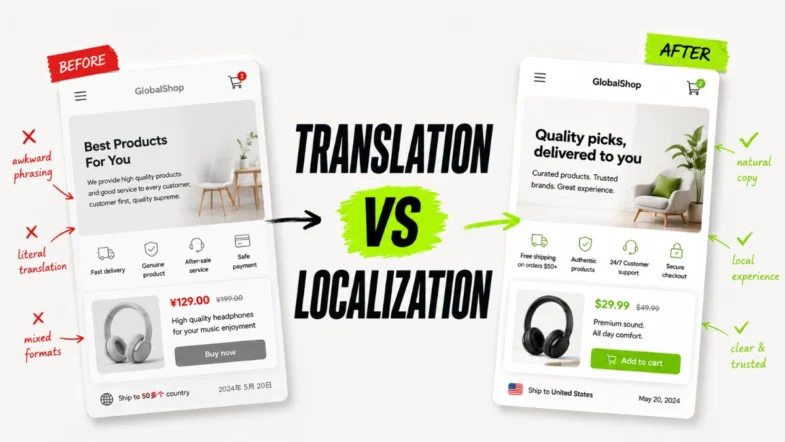
Copywriting SolutionsWhat is the difference between translation and localization? Translation means replacing words with their equivalents in another language, while localization involves adapting the entire user experience. Let’s check the real difference!
Research shows that 76% of online shoppers prefer to buy products with information in their native language. At the same time, 40% say that they will never purchase from websites written in other languages. However, a simple translation isn’t always enough. Many brands require high-quality localization to increase user engagement and improve conversion rates. So what’s the real difference? Our team tested and analyzed both approaches. Let’s explore what translation and localization actually mean, how to tell the difference, and why it matters to users.
At We-Right Factory, we approach localization through practical testing and real user experience. This article may contain affiliate links, but these do not impact our recommendations. When examining translation and localization practices, we use practical tests, real-life examples, and open assessment techniques.
What Is Translation?
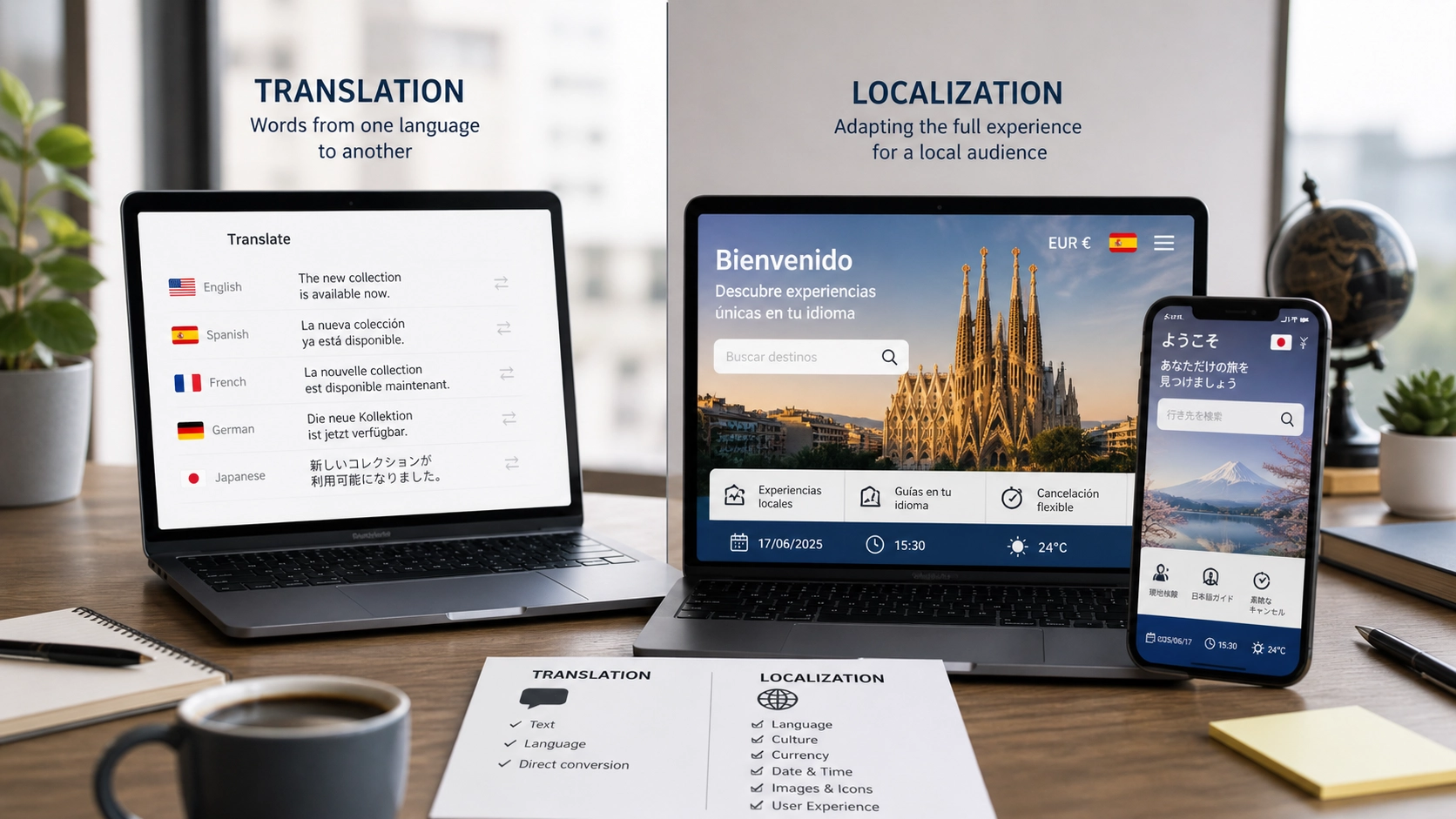
Translation is the process of converting text into another language, while preserving the meaning to the greatest extent possible. You usually don’t need any special tools for copywriting to make a translation – the main objective is to be precise. Translation is employed where exactness of words is more important than cultural adaptation. This is frequently the case for contracts, medical records, scientific papers, or technical procedures. In these cases it may cause misunderstandings if the text changes too much.
Let’s look at some important factors of translated content:
- Accuracy. The translator works to get the meaning across as much as possible as the original. All the details are important, as slight changes in details can affect the context.
- Literal Wording. A number of phrases are close to the original structure – this is to maintain the author’s meaning.
- Structure Preservation. Usually, there is no change in the order of paragraphs, sentences, and formatting. The translation is as close to the original as possible.
- Terminology Consistency. There are repetitions of words and phrases throughout the text. This is important in legal, medical, engineering, and financial areas.
- Neutral Tone. The translation does not change the tone of the text. The objective is not to please the local community, but to be clearly understood.
We have noticed that healthcare, legal services, manufacturing, and software documentation-related industries often require direct translation. In these areas, accuracy is a more important factor than marketing style.
Real Example
For clarity’s sake, we translated the product description from a Chinese retailer that sells electric kettles. The text has been translated into English using simple machine translation. See the screenshot with the translation below.
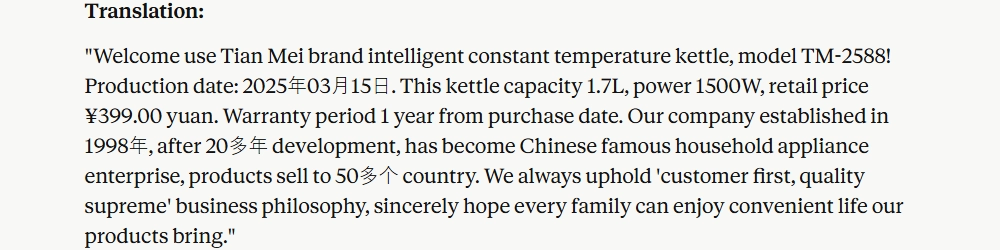
On first reading, the meaning is clear. However, there are a number of problems that could confuse or distract English speaking users. Let’s examine the primary issues that remained in the translated version:
- Awkward sentence structure. Some lines do not flow naturally in English but follow Chinese grammar. The writing is stilted and mechanical.
- Mixed language formatting. Chinese characters such as “年” and “月” remain in the date, which compromises readability for English speakers.
- Unnatural phrasing. It is strange to hear expressions like “products sell to 50多个 country” in English. Native readers don’t talk like that.
- Currency mismatch. The price remains in yuan without context or conversion. It might not be immediately obvious to many users beyond China.
- Brand messaging feels forced. The words “customer first, quality supreme” are directly quoted from the original language. The tone is not authentic for Westerners.
- Grammar inconsistencies. Articles or word order are lacking in a few sentences. This reduces people’s confidence in the product description.
What Is Localization?
Localization is the process of modifying content, products, or services for a particular market and culture. Its purpose is to make the product seem a local creation rather than an import. While translation involves just adapting the content to different languages, localization requires adjusting elements of the experience to align with local user habits and expectations. This task is often entrusted to technical writing services that use a comprehensive approach to content localization.
Let’s take a look at what localization typically entails:
- Currency and measurements. The prices and units are converted into local standards, and payment options are subject to change. This enables users to grasp information more quickly.
- Date and time formats. There are a variety of ways to write dates across countries. When making purchases or bookings, there is no risk of confusion due to localization.
- Tone and humor. Jokes, slogans, and casual phrases can be entirely different. Wherever you go, what is normal in one country can feel weird in another.
- UX and navigation. The layout, reading direction, and the position of the button are subject to change based on local usage. This makes the product more user-friendly.
- Images and colors. The meaning of visual options can vary from culture to culture. Certain colors or symbols can illicitly evoke the wrong response.
- Legal and cultural regulations. Some markets have specific disclaimers or content restrictions. Localization helps brands to avoid compliance problems.
One such example is Netflix. The company went beyond just translating the menu when entering the Japanese market. It adapted movie thumbnails, modified recommendation logic based on local viewing habits, and modified content presentation for local preferences.
Real Example
For comparison, our team localized the same description of an electric kettle instead of simply translating it. The content was restructured for the English-speaking buyer using some business-writing tricks, but the meaning remains the same. You can see the result below.

Read also our article: How to Write Responsible Gambling Messages Without Empty Phrases
The localized version feels significantly more natural to English-speaking users. Product information is more transparent, the text reads local, and the message is more in line with the English-speaking ecommerce standard.
The following are the major changes from the translated version:
- Natural product naming. The product was renamed as “AquaPerfect Pro 1700, your new smart temperature kettle” from “Tian Mei brand intelligent constant temperature kettle, model TM-2588”. The new version is cleaner and more convenient for English speakers to remember.
- Localized currency. “¥399.00 yuan” was changed to “$59.99.” Users don’t have to do currency conversion in their heads to understand the price.
- Cleaner date format. “2025年03月15日” became “March 15, 2025.” This is based on the standard format used in the English-speaking markets.
- Better marketing tone. The slogan “Customer first, quality supreme” was changed to “We believe great mornings start with the right cup”. The localized line is more natural and less robotic.
- Improved readability. “Chinese famous household appliance enterprise after 20多 years” was revised to “After over 20 years of development, it has become a Chinese well-known household appliance enterprise loved by more than 50 countries.” The message remains the same, but sounds natural.
- Cultural adaptation. “Sincerely hope every family can enjoy the convenient life our products bring” was changed to “We’re proud to bring that experience into your home.” The new version is more personable and more inviting to connect with.
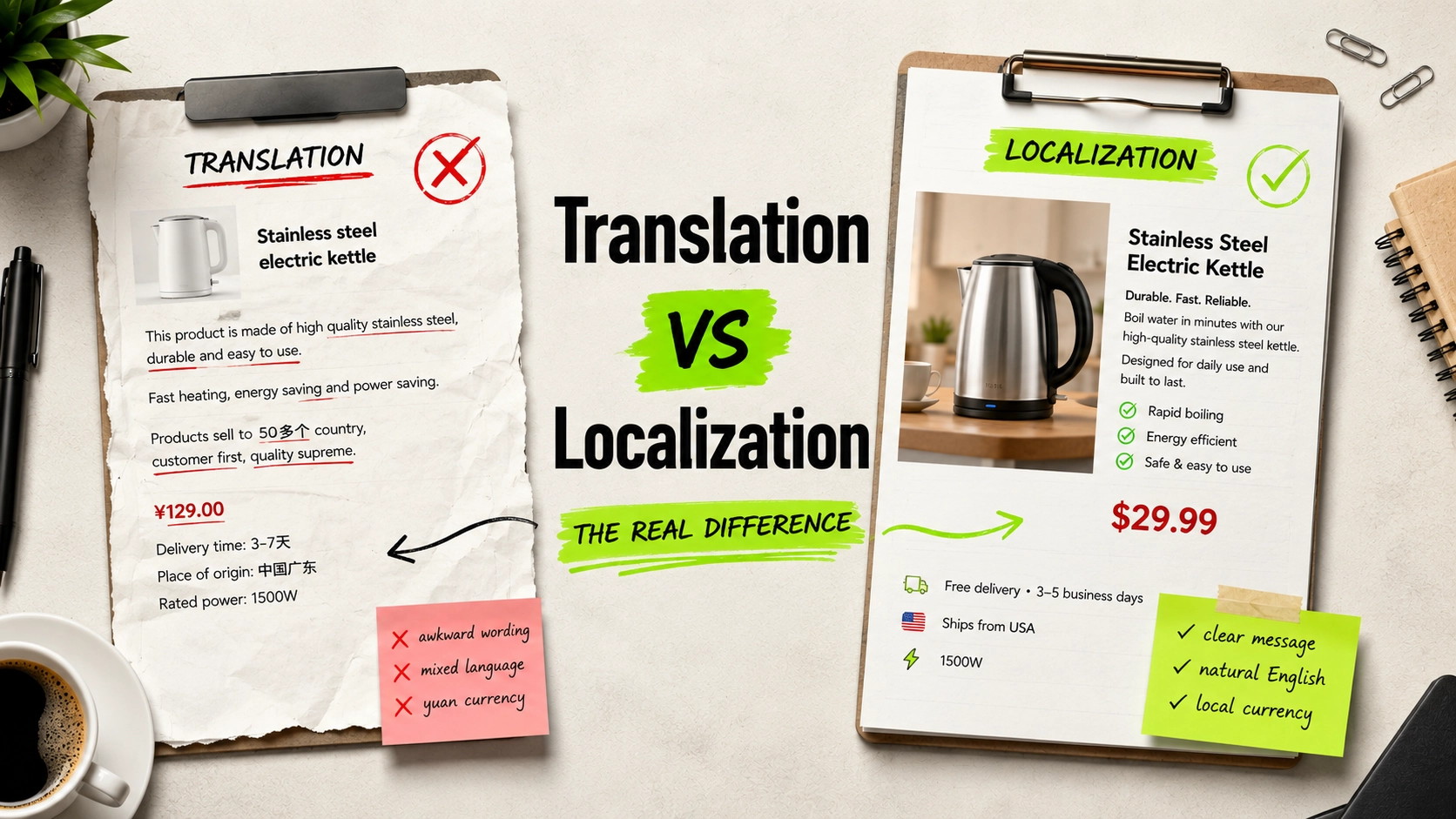
The localization made the text sound as if it were written for English-speaking shoppers. Users can comprehend the message more quickly, trust the product more readily, and navigate the purchase cycle more smoothly.
Translation vs Localization – Major Differences Side by Side
For comparison, our team created a quick, easy table comparing translation and localization. These terms are often confused as being synonymous. In fact, they are used to working on different jobs. Let’s compare them in the key areas that impact content, products, and customer behavior.
| Parameter | Translation | Localization |
| Main goal | Transfers meaning into another language | Adapts content for a local audience |
| Focus | Words and sentence accuracy | User habits, culture, and expectations |
| Currency and units | Usually remain the same | Converted to local formats |
| Tone of voice | Changes to the local style of communication | Changes made to suit local behavior |
| Date and time formats | Often copied without change | Rewritten for regional standards |
| Marketing phrases | Literal translation | Reworked to sound natural |
| UX elements | Few changes made | Changes made to suit local behaviour |
| End result | Understandable content | Native content |
Now compare the two descriptions of kettles we made above. The translated version retains the original words, but is rigid and awkward. The localized version reads like a product page originally written for English-speaking customers.

Our Conclusion
Translation helps users to understand content in a different language. Localization takes it a step further by bringing the whole experience to a particular market. If you are looking for a simple understanding, translation might be the answer. Localization often proves more effective when you are looking to build trust, drive engagement, and improve conversions.
FAQ
What is the difference between translation and localization?
Translation is the process of converting text from one language to another. Localization adapts the entire user experience, including the tone and format of content, visuals, pricing, and cultural information, for each market.
Will AI replace localization?
AI can help accelerate translation and adaptation. However, there will still be a need for human input regarding culture, slang, humor, legal context, and specific communication decisions.
Is it a British English translation or localization?
It depends on the exact adjustments. Translation is using the word “colour” instead of the word “color”. Localization is adapting tone, pricing, slang, and formats.



You might also like
Discover other helpful articles handpicked for you, based on popular topics and recent publications.

In our research, Responsible Gambling messages often miss their objective. Users ignore it when it feels dry, repetitive, or disconnected from reality. Read the article to learn how to change the situation.
 May 20, 2026
 397
397

Tired of writing emails and posts that clients ignore? Business writing doesn’t have to be boring. With just 6 simple tricks, from strong headlines to clear CTAs, you can turn dry texts into engaging messages.
 May 13, 2026
411
May 13, 2026
411

Every copy looks similar – until you see the process behind it. This article breaks down why expert copywriting agencies charge more, what truly goes into their work, and how to tell the difference between words that fill space and content that drives growth.
May 13, 2026
394

We-Right Factory content writers will explain how to create honest casino reviews that rank very high in search engines. We will share 10 recommendations we use ourselves and provide detailed examples.
May 13, 2026
751

“Companies don’t just want content — they want results: stronger SEO, trust, and customer loyalty. Outsourcing delivers exactly that — quickly, professionally, and with purpose,” say the experts at We–Right Factory.
September 28, 2025
493
Your First 1,000 Words,
Free of Charge
Free of Charge
See firsthand the quality of our content creation services. Complete the form to get a personalized 1,000-word sample tailored to your needs.