
 EN
EN
 UA
UA
Home
 BlogWriting BasicsWhat Are Modal Verbs in English Grammar: A Beginner’s Guide
BlogWriting BasicsWhat Are Modal Verbs in English Grammar: A Beginner’s Guide
What Are Modal Verbs in English Grammar: A Beginner’s Guide
Writing BasicsModal verbs in English grammar are the secret to expressing yourself clearly. From asking polite questions to showing certainty, these helpers transform basic sentences into nuanced communication.
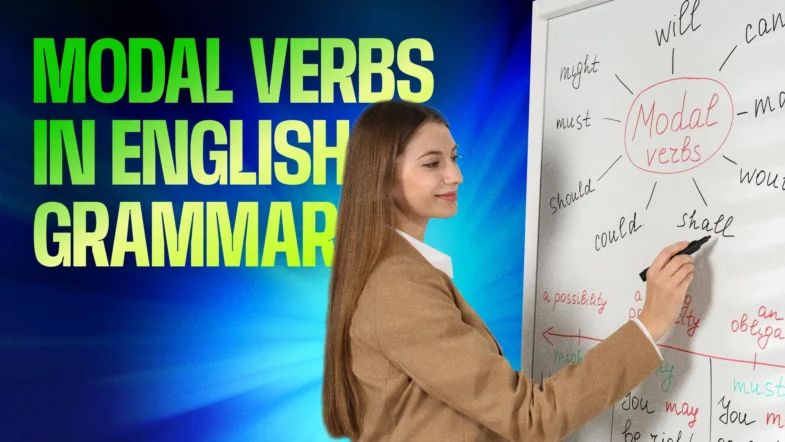
Modal verbs in English grammar, also called auxiliary verbs and helping verbs, give depth and meaning to phrases. They help us understand the speaker’s intention and give context to what is said. Get to know what modal verbs exist and how to use them correctly.
Introduction to Modal Verbs in English Grammar and Their Functions
In English, modal verbs do a lot of the behind-the-scenes work to make certain our communication is as clear as possible. See the table to find out the key modal verbs in English grammar and their functions.
| Modal Verb | Primary Meaning | Main Functions | Example |
| Can | Ability | Express capability, possibility | I can speak English. It can rain tomorrow. |
| Could | Past ability, possibility | Polite requests, hypothetical situations | I could swim when I was five.Could you help me? |
| Shall | Formal future, obligation | Offers, suggestions, formal promises | Shall I open the window? I shall return by noon. |
| Should | Advisability, obligation | Recommendations, expectations | You should see a doctor. The train should arrive soon. |
| Will | Future certainty, willingness | Predictions, promises, decisions | It will rain tomorrow. I will help you. |
| Would | Conditional, habitual past | Polite requests, hypothetical situations | Would you pass the salt? I would go if I could. |
| May | Permission, possibility | Formal permission, polite possibility | May I leave early? It may snow tonight. |
| Might | Weak possibility | Uncertain possibility, polite suggestions | I might be late. You might try calling again. |
| Must | Strong obligation, certainty | Requirements, logical deduction | Students must attend class. You must be tired. |
| Have to | External obligation | Necessity imposed by circumstances | I have to work late tonight. We have to follow the rules. |
How to Write Sentences Using Modal Verbs in English Grammar
Modal verbs follow a simple pattern in English sentences: SUBJECT + MODAL + BASE VERB + REST OF SENTENCE. The subject (like «I», «she», or «the students») comes first, followed by the modal verb (can, will, should, etc.), then the main verb in its base form (without «to» or any endings), and finally any additional information. Explore the key examples of modal verbs in English grammar usage.

Talking About the Future
Will is one of your go-to modal verbs in English Grammar for future events. Shall works too with «I» and «We», but it sounds formal and old-fashioned, especially in American English. Here are some examples:
- He will forget his umbrella if you don’t remind him.
- What will it be like, living in the 21st century?
- We’ll all be dead in a hundred years.
- Stop crying! It won’t make things any better, you know.
Expressing Personal Plans
When you’re stating your intentions, will is the standard choice. Shall can work with «I» and «We», but again, it’s less common in everyday speech. Example uses:
- I’ll be back in a minute.
- I won’t ever speak to him again.
- We will overcome all difficulties.
Making Offers and Suggestions
British English uses shall for questions when offering help or making suggestions. American version typically sticks with will or other modal verbs in English grammar constructions. Usage examples:
- Will you help me with my homework? (request)
- No. I won’t. (refusal)
- I’ll do it for you if you like. (offer)
- Shall I give you a hand with the dishes? (British offer)
- Shall we buy her a present? (suggestion)
Describing Abilities
Can talks about general abilities. Could describes past abilities or helps make polite requests. Avoid using could for particular past events that actually happened – use «managed to» instead. A few examples:
- I can speak Chinese, but I can’t write it.
- She could swim for miles when she was younger.
- She finally managed to pass the exam. (not «could pass»)
- Can you close the window, please? (request)
Asking for Permission
Can is one of casual and common modal verbs in English grammar. May sounds more formal. Could and might are even more polite but only for asking permission, not giving it.
- Can I have another piece of cake, Dad?
- No, you can’t. You’ll make yourself sick.
- Do you think I could leave early tonight?
- You may leave at 5:30 if you like.
- Might I have a word with you? (very formal, British)
Discussing Hypothetical Situations
Would appears in conditional sentences and polite requests. It signals that something isn’t real or definite. Sample uses:
- I would love to travel round the world. (if I had the chance)
- What would you do if you won a lot of money?
- I wouldn’t have gone, if I’d known he was going to be there.
- Would you like some tea? (polite invitation)
Read also our article: The Hidden Standards of Dutch iGaming Texts: Writing for Players, Not Algorithms
Expressing Possibility
May and might suggest something could happen. Could implies it’s less likely. Can appears mainly in questions about possibility, or to mean «sometimes». Examples include:
- She may go to Paris tomorrow.
- They might be meeting her.
- Joe might have missed the train.
- Where can they be?
- Learning English can be fun.
- Don’t touch that wire. It could be dangerous.
Showing Certainty
Must modal verbs in English grammar constructions express a very strong certainty – stronger than will. Can’t shows you’re certain something isn’t true – stronger than won’t. For past certainty, use must have and can’t have. Examples:
- Joe must be at least 45. (I’m sure he is)
- No, he can’t be over 40. (I’m sure he isn’t)
- He must have graduated years ago. (I’m certain he did)
- We can’t have been at college together. (I’m certain we weren’t)
Stating Obligations
Must creates strong obligations. For past obligations, use had to. To show there’s no obligation, use don’t have to or don’t need to. Must not means something is forbidden. Use cases:
- You must finish this job by tomorrow.
- He had to finish the job by the next day.
- You don’t have to do it until next week. (it’s not necessary)
- You must not smoke in the cinema. (it’s forbidden)
- You needn’t have bought me a present. (but you did anyway)
Giving Advice and Suggestions
Should and ought to help give advice or make suggestions. They’re interchangeable, though should is more common.
- You should give up smoking. (advice)
- We ought to go to that new Japanese restaurant sometime. (suggestion)
- The farmers should have been consulted. (but they weren’t)
- You shouldn’t work so hard, you know.
Indicating Probability
Should and ought to express what you expect to happen, but they’re not as strong as must or will. For example:
- Their meeting should be over now. (I expect it is)
- He ought to be home at 5 o’clock today. (I expect he will be)
- They should have received our letter by now. (I expect they have)
Final Words on Modal Verbs in English Grammar
As you can see, modal verbs in English grammar are essential for many functions. Now you have seen how they are used, try putting them into practice when you speak and write.
Frequently Asked Questions About Modal Verbs in English Grammar
Do Modal Verbs in English Grammar Change Form?
No, modal verbs stay the same regardless of the subject. You say «I can», «he can», «they can» – never «he cans» or «they cans». They don’t take -s, -ed, or -ing endings.
How Do I Make Modal Verbs in English Grammar Negative?
Add «not» after the modal: «cannot» (or «can’t»), «will not» («won’t»), «should not» («shouldn’t»). Note that «cannot» is one word, and «will not» becomes «won’t».
Can Modal Verbs in English Grammar Stand Alone?
Yes, in short answers or responses. «Can you drive?» «Yes, I can.» «Will you come?» «I might.» The main verb is understood from context.



You might also like
Discover other helpful articles handpicked for you, based on popular topics and recent publications.

Dutch iGaming content follows its own unwritten rules. From compound words to native phrasing, every choice you make shapes how real your text sounds. Here’s what separates professional Dutch writing from “almost-there” translations.
 January 14, 2026
 230
230

Discover the meaning of adage phrases and how they help writers add depth and relatability to their work. Explore 20 timeless examples and the lessons they teach.
December 17, 2025
490