


Stop words are common words that usually do not add significant meaning to a sentence or search query. These words appear frequently in almost every text and are often filtered out during search processing, keyword analysis, and natural language processing (NLP).
In SEO and search technologies, stop words help simplify data analysis, reduce processing complexity, and improve the efficiency of information retrieval systems. However, modern search engines no longer completely ignore all stop words. In many cases, they help algorithms better understand context and user intent.
What Are Stop Words
Stop words are high-frequency words that often carry limited standalone semantic value and may be filtered out during text processing tasks.
The term “Stop Words” is widely used in SEO, search engines, machine learning, and NLP systems. Stop words usually include articles, prepositions, conjunctions, pronouns, and auxiliary verbs.
Stop words include “and,” “in,” “on,” “this,” “the,” “of,” “a,” and other similar parts of speech. Stop words appear in almost every text, so search engines may assign them lower importance during content analysis.
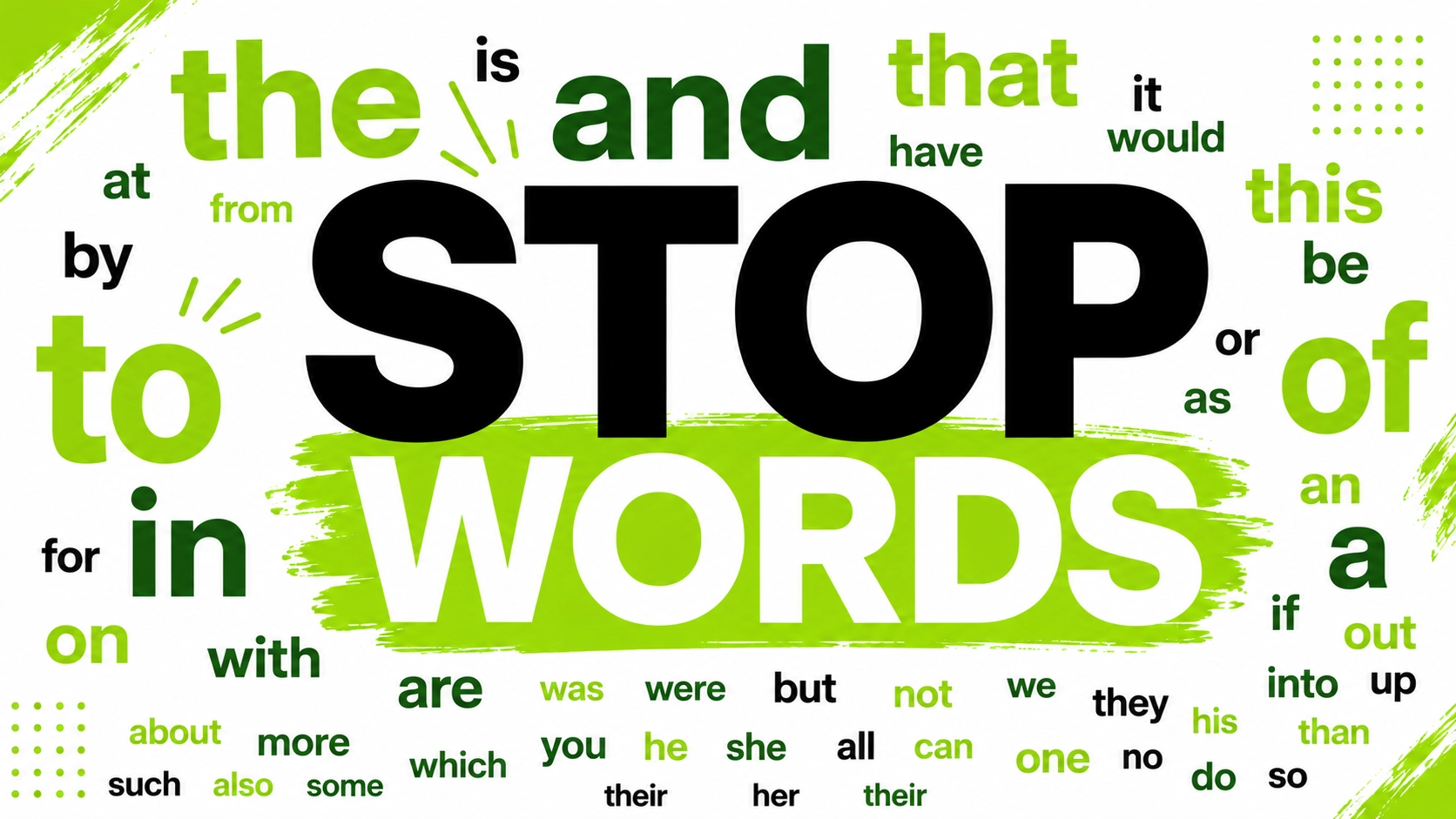
These words appear so frequently in content that search systems may treat them as low-priority terms during analysis.
Stop words are commonly involved in:
- simplifying search query processing;
- speeding up text analysis;
- reducing dataset complexity;
- improving indexing efficiency.
The table below explains where stop words are most commonly used.
| Field | Application |
| SEO | Keyword and query analysis |
| Search Engines | Filtering insignificant words |
| NLP | Text preprocessing and classification |
| AI Systems | Token reduction and language analysis |
| Contextual Advertising | Search phrase optimization |
| Data Analytics | Dataset cleaning and filtering |
Main Types of Stop Words
Different languages use different stop words. In English, they are usually short functional words that frequently appear in sentences and help connect ideas naturally.
| Category | Examples |
| Articles | a, an, the |
| Prepositions | in, on, at, from, to |
| Conjunctions | and, but, or |
| Pronouns | he, she, they, it |
| Auxiliary Verbs | is, are, have, do |
It is important to understand that stopword lists vary by language, search engine, NLP model, and SEO tool.
For example, Google, Bing, and text analysis platforms may process stop words differently depending on context.
How Stop Words Affect SEO
Older search algorithms often treated stop words as low-priority terms during indexing and query processing. Older algorithms focused mainly on exact-match keywords and filtered out many common words during indexing.
Today, search works differently.
Google’s algorithms now rely on semantic analysis and natural language understanding technologies such as BERT. As a result, stop words may influence how search engines interpret context, intent, and relationships among words.
For example:
- “Flights to London”
- “Flights from London”
Even though “to” and “from” are stop words, they completely change the meaning of the query.
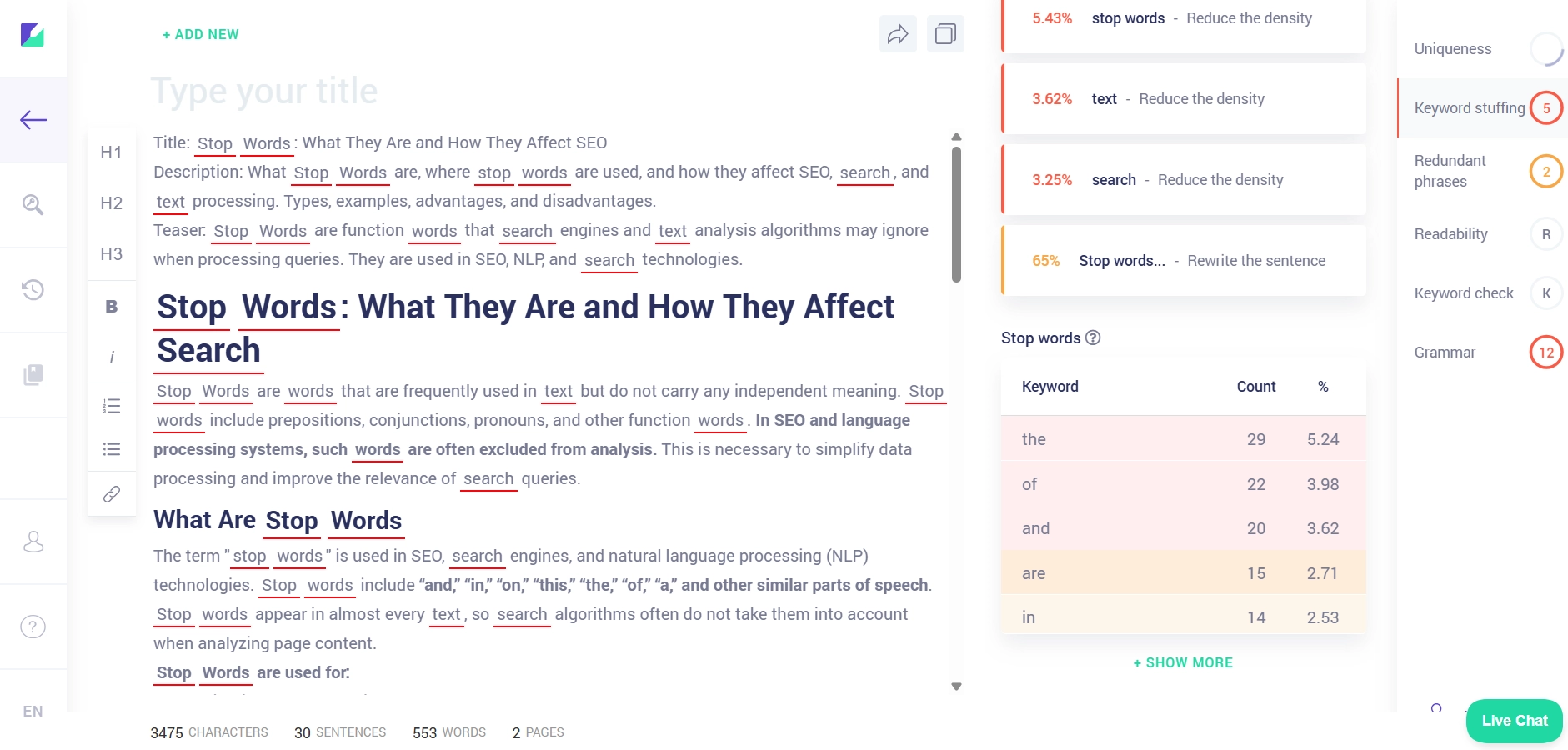
Stop words may:
- influence search intent;
- affect semantic interpretation;
- improve natural language flow;
- clarify relationships between words.
At the same time, completely removing stop words from SEO content is not recommended. This often makes text sound robotic and negatively affects readability.
Advantages and Disadvantages of Removing Stop Words
Removing stop words can simplify text processing and reduce computational complexity in some NLP systems. However, it may also reduce contextual understanding and affect the natural flow of language.
In older SEO and NLP systems, stop word removal was much more aggressive. Today, many algorithms preserve stop words when they help clarify semantic meaning or user intent.
| Advantages | Disadvantages |
| Faster text processing | Loss of semantic context |
| Smaller datasets | Reduced readability |
| Cleaner keyword analysis | Possible meaning distortion |
| Simplified indexing | Less natural sentence structure |
| Reduced processing complexity | Lower contextual accuracy |
As a result, modern AI and search systems typically combine filtering with contextual analysis rather than removing stop words entirely.
The Role of Stop Words in Modern Search
Stop words remain an important element of search systems, SEO technologies, and NLP models. Although search engines have become significantly better at understanding language and context, stop words still help search engines and AI systems interpret context, sentence structure, and user intent more accurately.
Today, stop words are no longer treated as universally insignificant terms. In many cases, they help search engines understand relationships between terms, clarify intent, and improve the accuracy of search results.
FAQ
Stop words usually include function words such as “and,” “the,” “in,” “on,” “of,” “to,” and “a.” These words appear frequently in text and are often filtered during processing.
Yes. Modern search engines may consider stop words when they influence context, search intent, or semantic meaning within a query.
No. Completely removing stop words often makes text sound unnatural and reduces readability. In most cases, natural language structure is more important.
Not completely. Modern search engines use semantic analysis and may process stop words differently depending on context and query intent.



Learn key terms and concepts to navigate content writing, SEO, and iGaming confidently.

Free of Charge