
 EN
EN
 UA
UA
Home
 BlogSEO & MarketingDR vs DA: What’s the Difference and Which One Should You Trust
BlogSEO & MarketingDR vs DA: What’s the Difference and Which One Should You Trust
DR vs DA: What’s the Difference and Which One Should You Trust
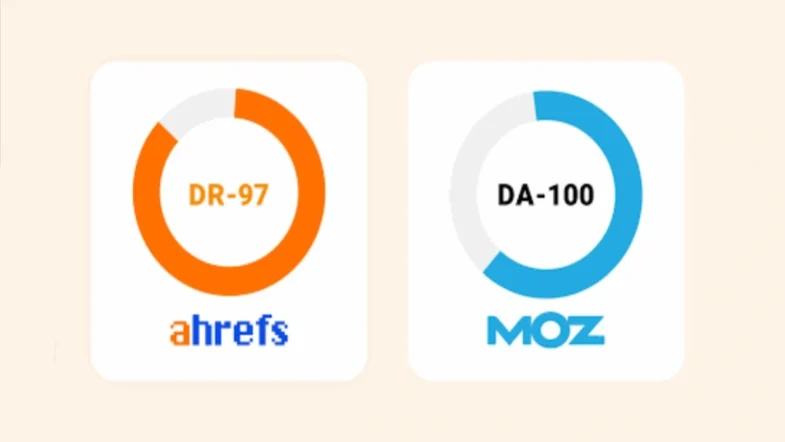
SEO & MarketingWe tested Domain Rating (DR) from Ahrefs and Domain Authority (DA) from Moz to evaluate their real impact on SEO and link building. In this review, our team shares test results, explains key differences, and highlights where each metric works best.
The We-Right team compared two of the most popular authority metrics: DR from Ahrefs and DA from Moz – to see which one deserves your trust. Although our review may affiliate links, you can be confident that all insights are confirmed by data and follow strict editorial standards.
Today, marketers rely on website authority metrics to evaluate link quality. That’s because authority scores have a direct impact on SEO growth and link-building strategies. Among these metrics, Domain Rating (DR) and Domain Authority (DA) are the most used tools. Both try to measure the trust and quality of a website backlink profile, but they do it in different ways.
Understanding these metrics is key for smarter SEO decisions. If you use DR and DA correctly, you can select better link opportunities, avoid wasting budget, and increase traffic more effectively.
In this review, the We-Right team thoroughly tested both metrics. Our goal is simple: to show you the difference and guide you on which one you should trust more.
What is Domain Rating (DR)?
Domain Rating is a metric by Ahrefs that was launched in 2018. It runs on a 0–100 scale that measures backlink profile quality. A website with a higher DR typically has a stronger backlink structure, which means it’s more likely to pass link equity. Ahrefs updates DR daily by using live backlink data. This makes it a widely trusted metric in SEO.
How is DR Calculated
Ahrefs calculates it using link data from billions of crawled pages. The system checks not just numbers but also quality and context of links. Here’re what data the formula focuses on:
- Quantity of backlinks – total number of inbound links that point to your site;
- Referring domains – unique domains linking to your site, not just link volume;
- Link authority – how strong or trusted those linking domains are.
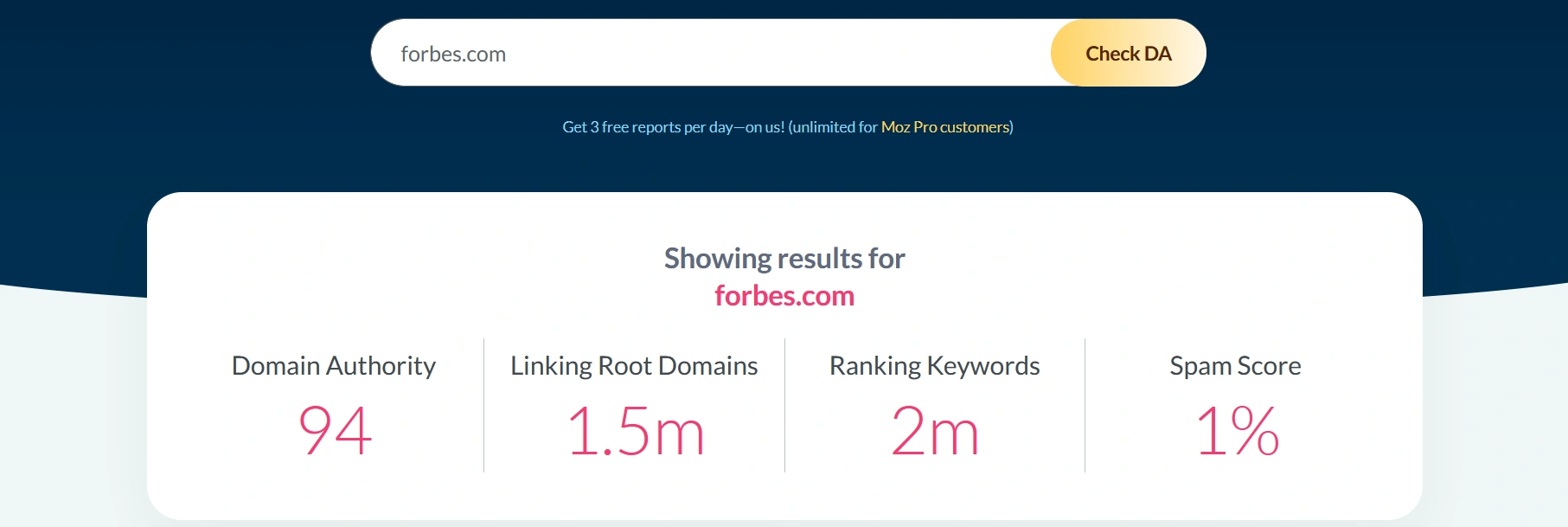
From our side at We-Right, we tested forbes.com. Its DR was 94, which shows how powerful the backlink profile can be. You’ll see the results below.

DR: Strengths and Limitations
We tested DR and found that it has both strong points and weak spots. Below is a quick table so you can see both sides clearly.
| Strengths | Limitations |
| Real-time backlink data | Not a direct Google ranking factor |
| Strong link profile focus | Can be affected by link spam |
From our review, DR is a solid measure for backlink quality, but it’s not the final sample for rankings.
What is Domain Authority (DA)?
DA is a score that predicts how likely a site is to rank in search engines. The measurement also applies a 0–100 scale with a logarithmic curve, which means it gets harder to reach from 70 to 80 than from 20 to 30. Domain Authority estimation was created by Moz in 2010. DA remains one of Moz’s core SEO tools used by marketers worldwide.
How is DA calculated?
DA uses a machine learning model built by Moz. The system evaluates multiple factors beyond just backlinks. The score predicts the ranking potential of a domain by weighing link and site-level data. Here are the main signals:
- Link metrics – total inbound links pointing to the site;
- Site age – older domains often gain more trust;
- Site size – bigger websites with more indexed pages tend to score higher;
- Other SEO factors – elements like content quality and keyword presence.
DA updates occur less frequently than DR and can take weeks. From our side at We-Right, we tested forbes.com. Its DA was 94, similar to the DR test, despite the differences between the algorithms of both tools.
DA: Strengths and Limitations
We reviewed DA closely and saw positive points and weaker ones. Here’s a table that reveals them.
| Strengths | Limitations |
| Broader SEO factors considered | Slower updates, not real-time |
| Useful predictive measure for ranking | Less transparent, not a Google metric |
Read also our article: Top 10 Tips for iGaming Writing in 2025
DR vs DA: Major Differences
At We-Right, we tested both Domain Authority (DA) and Domain Rating (DR) under real outreach and SEO scenarios. To make the comparison clear, we lined up the metrics side by side based on our evaluations. This professional breakdown shows not only the technical differences but also how each metric performs in practice, helping you decide which one to trust for link building and SEO analysis.
| Criteria | Domain Authority (DA) | Domain Rating (DR) |
| Provider | Moz | Ahrefs |
| Data source | Moz link index | Ahrefs link index |
| Update frequency | Around once per month | Every 5–7 days |
| Focus | Ranking potential | Backlink popularity |
| Transparency | Less transparent model | Clearer backlink weight |
| Internal links inclusion | Not included | Included in calculation |
| High-quality links affect | Strong influence | Quantity of unique domains matters more |
| Best for | Link building and SEO analysis | SEO competitiveness evaluation |
From our side, DA works well for predicting rankings, while DR gives a clearer picture of link strength. Both matter, but they serve different goals in SEO work.
Which Metric Should You Trust?
From our testing, we saw that both metrics are good in different areas. Neither is universally “better,” but each works best in specific contexts. Here’s how you can use them:
- Trust DR when checking backlink quality – it’s excellent for link-building campaigns. For example, if a blog has DR 70 but DA 40, it still sends good referral traffic because of its link equity.
- Trust DA when estimating domain strength – it helps gauge ranking chances. For instance, a DA 85 site often outranks a DA 50 competitor, even with fewer backlinks, demonstrating the predictive power of the score.
DR+DA: Combining Both Metrics for SEO Strategy
From our experience, tracking DR and DA together provides a more comprehensive view. DR shows backlink popularity while DA predicts ranking strength. If both are combined, the traffic rates will likely improve. At We-Right, we recommend using both tools simultaneously. This balance avoids a blind approach to link building and helps inform smarter SEO decisions.
Conclusion: DR or DA?
From our review, DR and DA serve different purposes. DR helps you judge backlink strength quickly. DA is better for estimating ranking chances of entire domains.
Neither metric should stand alone if you want to get better SEO results. Based on our tests, we recommend using Ahrefs tool for link prospecting and Moz software for domain comparisons.
FAQ
Is a site’s Domain Rating the same as its Domain Authority?
No, they are different tools. DR is built by Ahrefs and measures backlink profile strength on a 0–100 scale. DA is by Moz and predicts ranking potential.
Which is more important, DA or DR?
Neither is more important across all cases. DR works best for backlink evaluation, while DA is useful for ranking predictions. Marketers often check both to make balanced decisions.
Is a high DR better than a high DA?
Not always. A site with high DR can have strong backlinks but still weak rankings. A site with high DA often ranks better overall. It depends on what you’re measuring – link popularity or domain strength.
Does Google use DA or DR as a ranking factor?
No. Both DA (Moz) and DR (Ahrefs) are third-party metrics and are not used by Google for rankings. Treat them as proxies for comparison, not targets to optimize for. Focus on real signals: high-quality content, relevant backlinks, technical health, and user experience.
What’s a “good” DR/DA for outreach?
It depends on your niche and goals. As a starting point, DR/DA 40–60+ often works well for general topics; however, in competitive niches, higher thresholds may be necessary, while in smaller niches, lower scores can still be effective. Always check relevance, traffic, and link placement quality – not just the number.
Why do DA/DR scores change suddenly?
Fluctuations typically originate from index updates (when the tools recrawl the web), gains or losses of backlinks, or model recalculations. A few new strong links – or the loss of a handful of powerful domains – can move the needle quickly. Expect normal variance and track trends over time rather than reacting to single-day swings.



You might also like
Discover other helpful articles handpicked for you, based on popular topics and recent publications.


iGaming content is not just writing – it is process control, QA discipline, and regulatory awareness. In this article, we break down how professional iGaming content writing agencies actually operate and how to distinguish structured expertise from content produced at scale without safeguards.
 February 23, 2026
 133
133

Not all casino bonus reviews are actually helpful. Learn how to write reviews that truly inform players, clearly explain key terms and conditions, and build lasting trust with your readers.
February 5, 2026
208

We tested different writing approaches to see what makes how-to guides work in practice. In this review, our team shares the 11 rules we recommend, explains why they matter, and shows how you can apply them. We are ready to share our verdict.
 January 24, 2026
72
January 24, 2026
72

Discover 10 expert-backed tips to improve your iGaming content in 2025 — from localization and tone to SEO, visuals, and user-focused writing that builds trust and engagement.
August 29, 2025
499

Medical writing combines science and clarity to create trustworthy healthcare content. This We–Right guide covers sourcing, terminology, and compliance — helping you write accurate, ethical, and audience-focused materials.
May 11, 2025
477